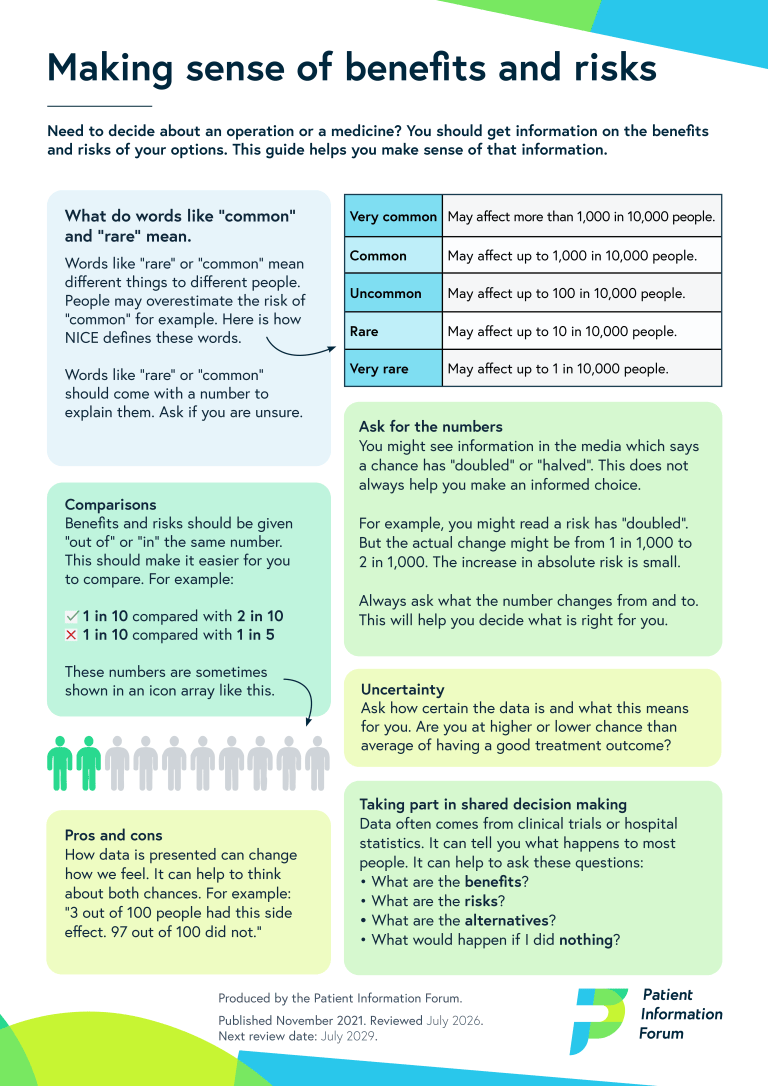

Need to make a decision about an operation or a medicine? You should get information on the benefits and risks of your options. This guide helps you make sense of that information.
What do words like “common” and “rare” mean?
Words like “rare” or “common” mean different things to different people. People may overestimate the risk of “common” for example. The table below shows how NICE defines these words. Words like “rare” or “common” should come with a number to explain them. Ask if you are unsure.
| Very common | May affect more than 1,000 in 10,000 people. |
| Common | May affect up to 1,000 in 10,000 people. |
| Uncommon | May affect up to 100 in 10,000 people. |
| Rare | May affect up to 10 in 10,000 people. |
| Very rare | May affect up to 1 in 10,000 people. |
Comparisons
Benefits and risks should be given “out of” or “in” the same number. This should make it easier for you to compare. For example use 1 in 10 compared with 2 in 10 not 1 in 10 compared with 1 in 5. These numbers are sometimes shown in an icon array like this:

Uncertainty
Ask how certain the data is and what this means for you. Are you at higher or lower chance than average of having a good treatment outcome?
Ask for the numbers
You might see information in the media which says a chance has “doubled” or “halved”. This does not always help you make an informed choice. For example, you might read a risk has “doubled”. But the actual change might be from 1 in 1,000 to 2 in 1,000. The increase in absolute risk is small. Always ask what the number changes from and to. This will help you decide what is right for you.
Pros and cons
How data is presented can change how we feel. It can help to think about both chances. For example: “3 out of 100 people had this side effect. 97 out of 100 did not.”
Taking part in shared decision making
Data often comes from clinical trials or hospital statistics. It can tell you what happens to most people. It can help to ask these questions:
- What are the benefits?
- What are the risks?
- What are the alternatives?
- What would happen if I did nothing?