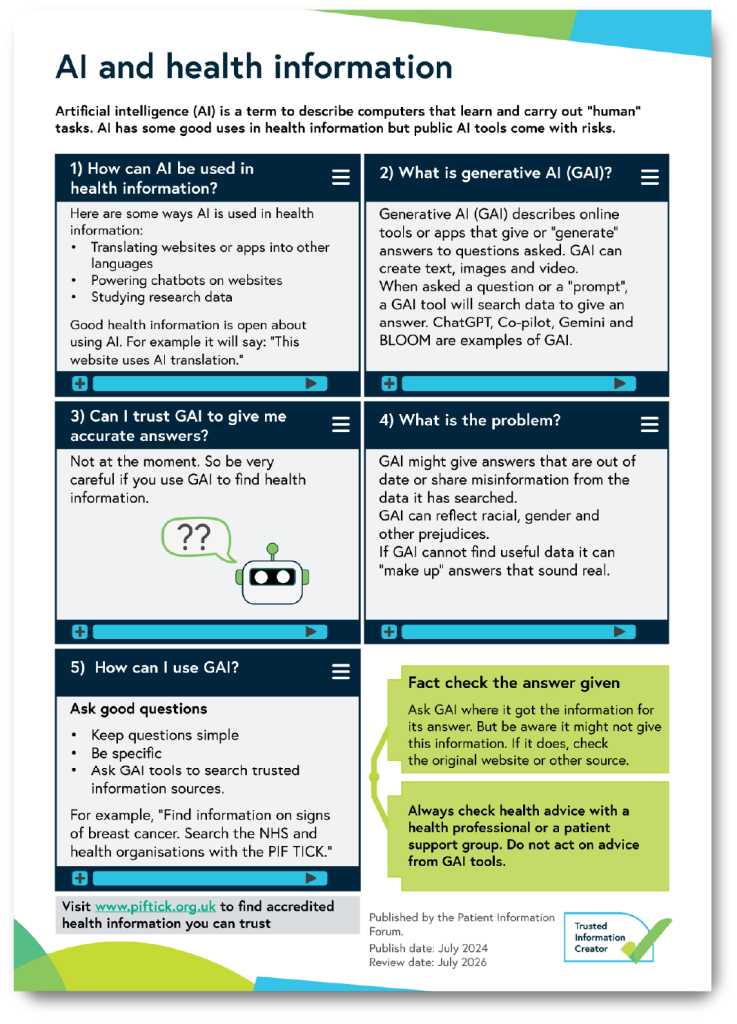
Artificial intelligence (AI) is a term to describe computers that learn and carry out “human” tasks. AI has some good uses in health information but public AI tools come with risks.
1) How can AI be used in health information?
Here are some ways AI is used in health information:
- Translating websites or apps into other languages
- Powering chatbots on websites
- Studying research data
Good health information is open about using AI. For example it will say: “This website uses AI translation.”
2) What is generative AI (GAI)?
Generative AI (GAI) describes online tools or apps that give or “generate” answers to questions asked. GAI can create text, images and video. When asked a question or a “prompt”, a GAI tool will search data to give an answer. ChatGPT, Co-pilot, Gemini and BLOOM are examples of GAI.
3) Can I trust GAI to give me accurate answers?
Not at the moment. So be very careful if you use GAI to find health information.
4) What is the problem?
GAI might give answers that are out of date or share misinformation from the data it has searched. GAI can reflect racial, gender and other prejudices. If GAI cannot find useful data it can “make up” answers that sound real.
5) How can I use GAI?
Ask good questions:
- Keep questions simple
- Be specific
- Ask GAI tools to search trusted information sources.
For example, “Find information on signs of breast cancer. Search the NHS and health organisations with the PIF TICK.”
Fact check the answer given
Ask GAI where it got the information for its answer. But be aware it might not give this information. If it does, check the original website or other source.
Always check health advice with a health professional or a patient support group. Do not act on advice from GAI tools.